Transforming Skies: Costa da Morte


Light & weather report

Writing with light the passage of time

TS Home / London / Costa da Morte / Elders´ Voices / AboutServices / Print  / Contact

Os nosos ceos

From Miradoiro38 in the village of Sofán, the camera's gaze sweeps over the rooftops, the wild arch of Carnota Bay, Caldebarcos, the sacred mass of Monte Pindo and the distant "End of the Earth": Cape Fisterra. Each frame, 80% sky, becomes a blank canvas for wind, storms, stars and sunsets; an ethereal opera cloth that rises and falls over everyday life. Calm sea, storm-carved clouds, rainbow arches, moonlit fishing boats: everything appears and disappears, marking the rhythms of the Costa da Morte. At night, the bay throbs with the activity of fishermen: their boats are lighthouses that connect the sea with the sky. Time here is a force: it sculpts mountains, shapes moods, defines architecture and tradition.

Weather report and text crafted in collaboration with Perplexity AI

October 2024: Daily reports

11 October 2024

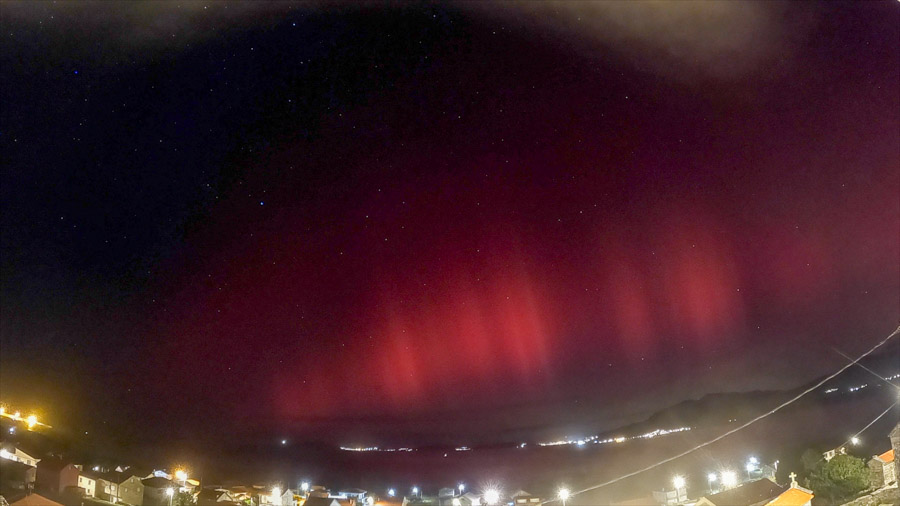
Panoramic night scene over Carnota Bay on Galicia’s Costa da Morte with bright red aurora borealis pillars above the village lights of Sofán, Monte Pindo, Caldebarcos and distant Cape Fisterra.

The sky writes an unusual story today

On 9 October 2024, an X1.8‑class solar flare erupted from active region AR 3848 on the Sun and launched a fast, Earth‑directed coronal mass ejection (CME) — a huge cloud of magnetised plasma.
This CME reached Earth on 10–11 October and violently disturbed the planet’s magnetic field, producing a severe G4‑level geomagnetic storm (Kp 8).
When that storm compressed and twisted Earth’s magnetosphere, large numbers of charged particles were funnelled  deep into the upper atmosphere at much lower latitudes than usual, including across Spain.
These particles excited oxygen atoms at high altitudes, which emit predominantly red light, so the aurora appeared as tall crimson arcs and curtains instead of the more common green bands, making the sky over Carnota glow red.
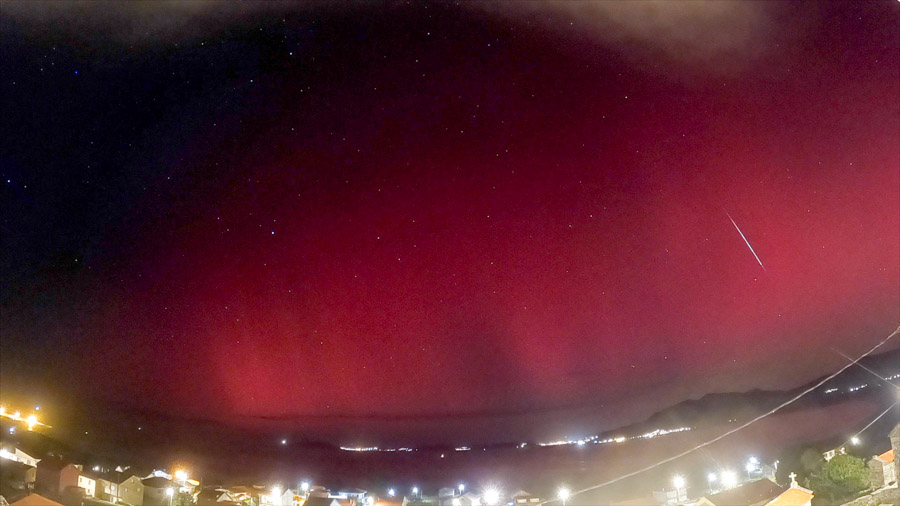
 

Panoramic night scene over Carnota Bay on Galicia’s Costa da Morte with intense red aurora borealis filling the sky and a bright meteor streaking down above the village lights of Sofán, Monte Pindo, Caldebarcos and Cape Fisterra.

A bright meteor streaks across a sky filled with red auroral light from the October 10–11-2024 geomagnetic storm, above Carnota Bay and the illuminated coastline of Sofán, Caldebarcos and Cape Fisterra on the Costa da Morte.

By the time dawn approaches, the aurora fades and the horizon pales; sunrise comes around 8:20 in the morning, with sunset near 7:50 in the evening, giving just over eleven and a half hours of daylight to follow the calm after the storm in space.

Temperatures move within a gentle autumn range, from about 13 °C before sunrise to around 19 °C in the early afternoon before easing back toward the mid‑teens at night.
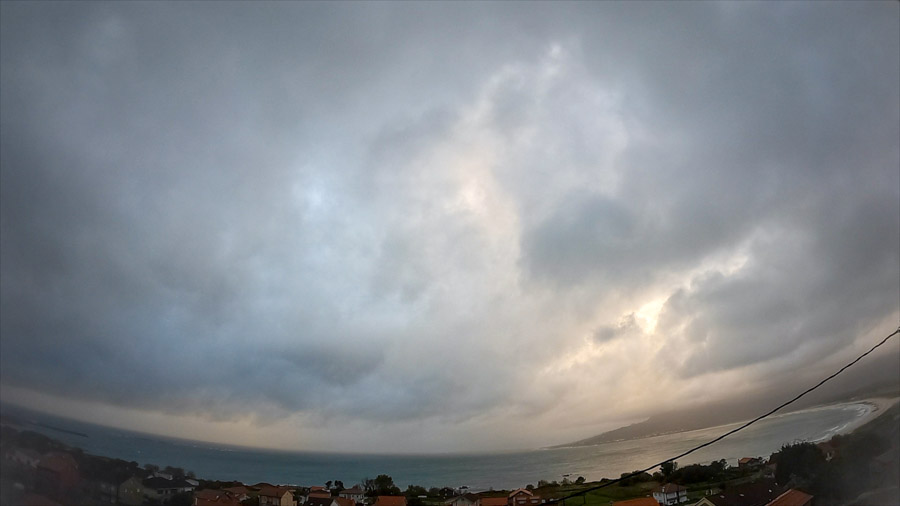
Late‑afternoon panoramic view over Carnota Bay on Galicia’s Costa da Morte with dark nimbostratus and stratocumulus clouds, rain haze and soft light over Monte Pindo, Caldebarcos and Cape Fisterra.

Thick nimbostratus and stratocumulus clouds close in over Carnota Bay , with rain curtains and a last glow of light above Monte Pindo, Caldebarcos and Cape Fisterra on Galicia’s Costa da Morte.


Winds over Carnota blow mainly from the northwest and west at 15–25 km/h, persistent but not extreme, brushing small whitecaps across the long, shallow beach.

Surface pressure remains close to 1016–1018 hPa, indicative of relatively stable conditions after earlier disturbances, supporting extended mid‑level cloud decks through much of the day.

The UV index peaks only around 3 to 4 at midday, a mild October sun that brightens the sea but no longer dominates the sky.
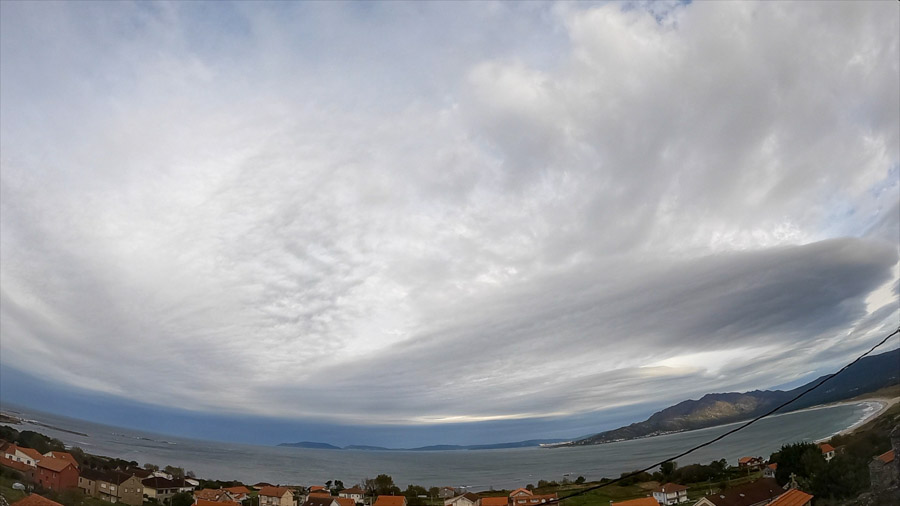
Midday panoramic view over Carnota Bay on the Costa da Morte with parallel bands of altostratus radiatus clouds above the rooftops of Sofán village, Monte Pindo, Caldebarcos and Cape Fisterra.

Bands of altostratus radiatus clouds sweep in parallel lines across the midday sky over Carnota Bay, above the rooftops of Sofán village, Monte Pindo, Caldebarcos and Cape Fisterra on Galicia’s Costa da Morte.


Tides trace their familiar rhythm: a low tide in the pre‑dawn hours exposing wide sandbars, a late‑morning high tide pushing the water toward the dunes, another low in the late afternoon, and a final high close to midnight that mirrors the quiet, starry sky left behind by the vanished aurora.
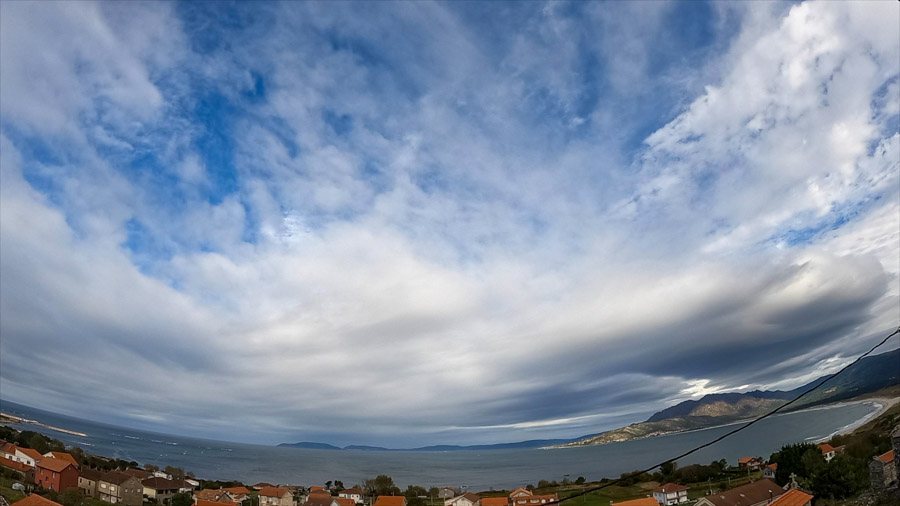
Early‑afternoon panoramic view over Carnota Bay on the Costa da Morte with mixed altocumulus and stratocumulus clouds and blue gaps above Sofán village, Monte Pindo, Caldebarcos and Cape Fisterra.

Altocumulus patches and a low stratocumulus deck sweep across the early‑afternoon sky above Carnota Bay, with the roofs of Sofán village, Monte Pindo, Caldebarcos and Cape Fisterra lining Galicia’s Costa da Morte.


This is a night when the north remembers you.

Instead of its usual invisible work in the upper atmosphere, Earth’s magnetic field lets its lines be seen, painted in red over the bay like slow‑moving fire.
The village below carries on with ordinary lights—street lamps, windows, the quiet geometry of houses—while above them something entirely un‑local unfolds, as if another planet had briefly slipped into the frame.
The sea is almost absent, only a thin, dark band at the bottom of the image, yet you can feel its presence: a flat mirror for a sky that refuses to be still.
To me, this photograph is a conversation between scales—human, terrestrial, solar—compressed into one exposure: pixels born from photons that started their journey days earlier on the Sun, finished here on the camera sensor over Costa da Morte.


View the 11th Oct-24 time lapse in the YouTube’s Channel


10 October 2024

The day opens under an Atlantic autumn sky: sunrise around 8:45 in the morning, sunset near 8:00 in the evening, a little over eleven hours of shifting light to paint the bay.

Temperatures start near 14 °C at dawn, climb towards 19 °C in the early afternoon, then drift back down into the cool mid‑teens after sunset.
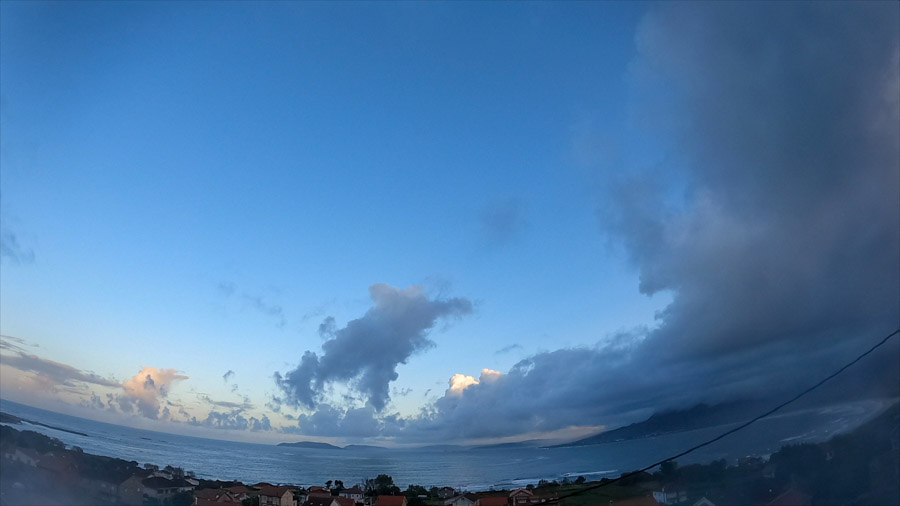
Evening panorama over Carnota Bay on the Costa da Morte with a towering cumulus congestus cloud above the sea, stratocumulus over Monte Pindo and the villages of Sofán, Caldebarcos and Cape Fisterra.

A towering cumulus congestus cloud rises over Carnota Bay while banks of stratocumulus wrap around Monte Pindo, with the rooftops of Sofán village and the curve of Caldebarcos and Cape Fisterra beneath a clearing evening sky.

Humidity stays high, mostly between 80 % and 90 %, so even the clearings in the sky feel washed with maritime moisture from the open Atlantic.

Winds blow predominantly from the northwest and west, around 15–30 km/h, pushing bands of showers and tall clouds across the bay and over the headland.
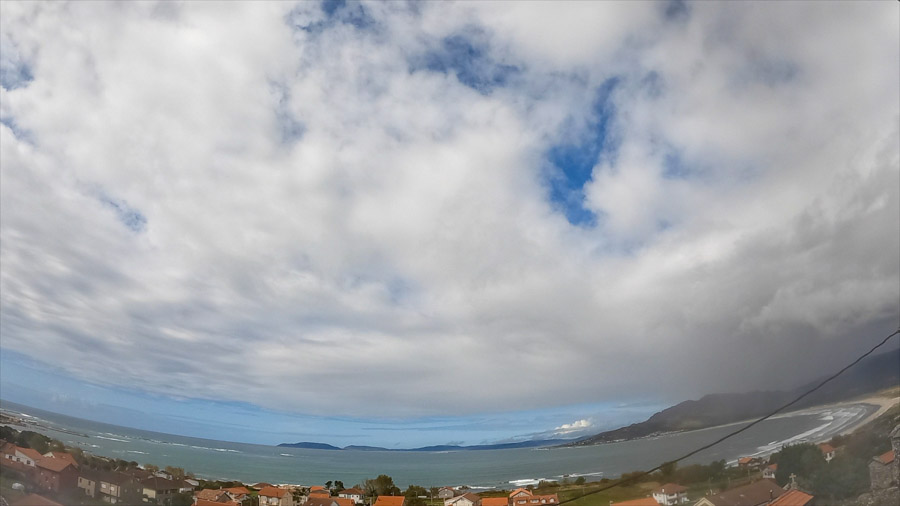
Panoramic daylight scene over Carnota Bay on the Costa da Morte with a developing cumulonimbus cloud line under a blue sky above the rooftops of Sofán, Monte Pindo, Caldebarcos and Cape Fisterra.

A wide sheet of stratocumulus clouds blankets Carnota Bay, opening into a blue‑sky “hole” above the Costa da Morte while the rooftops of Sofán village, Monte Pindo, Caldebarcos and Cape Fisterra line the coast below.

Winds sweep in from the west and northwest, generally between 15 and 30 km/h, at times gusty enough to ruffle the ocean into white streaks against the bay.

Atmospheric pressure sits in the low‑to‑mid 1000 hPa range, hinting at unsettled air and the passing of fronts above the headlands.

Under these clouds the UV index remains modest, peaking only around 3 to 4 at midday, giving a gentle but present autumn sun.
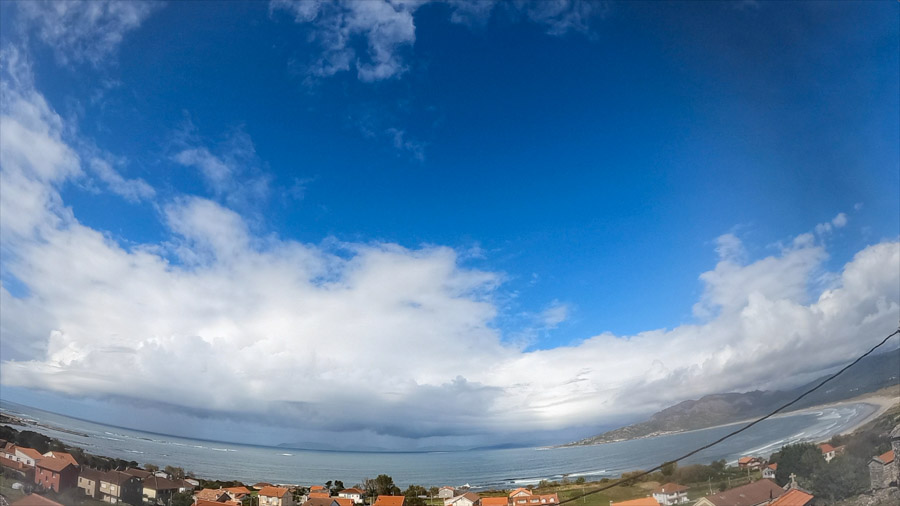
Panoramic daylight scene over Carnota Bay on the Costa da Morte with an overcast stratocumulus cloud layer broken by a blue sky hole above Sofán village, Monte Pindo, Caldebarcos and Cape Fisterra.

Daytime panoramic view from Sofán village on Galicia’s Costa da Morte, showing a broad line of cumulonimbus and cumulus clouds pushing in from the Atlantic across Carnota Bay, with strong sunlight breaking through over Monte Pindo, Caldebarcos and the distant headland of Cape Fisterra.

Atmospheric pressure sits near 1016 hPa, typical of passing fronts, with brief bright intervals framed by heavier, darker cloud masses.

Under these skies the UV index remains modest, peaking near 3–4 around midday, enough to silver the waves without the intensity of summer.

Daytime panoramic view from Sofán village on Galicia’s Costa da Morte, showing a broad line of cumulonimbus and cumulus clouds pushing in from the Atlantic across Carnota Bay, with strong sunlight breaking through over Monte Pindo, Caldebarcos and the distant headland of Cape Fisterra.

The tide draws its slow pattern: a low tide in the early hours, before sunrise, then a mid‑morning high tide, another low mid‑afternoon, and a final high close to midnight, each cycle re‑writing the edge of Carnota’s long beach.
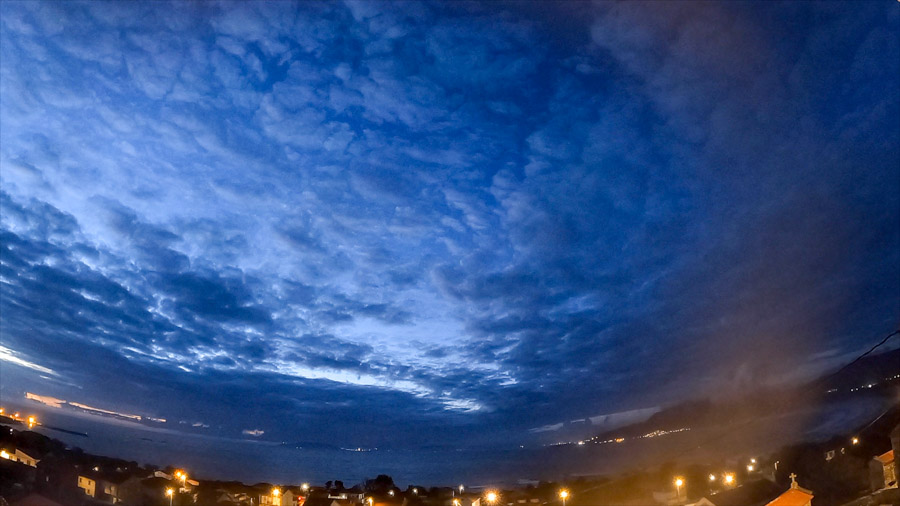
Blue‑hour panoramic view over Carnota Bay on the Costa da Morte with a textured layer of altocumulus stratiformis clouds filling the sky above the village lights of Sofán, Caldebarcos, Monte Pindo and distant Cape Fisterra.

A dense layer of altocumulus stratiformis clouds forms a textured “mackerel sky” over Carnota Bay during blue hour, as the lights of Sofán village, Caldebarcos and distant Cape Fisterra glitter along the Costa da Morte shoreline.

Here the day is peeling itself away in layers

Above the ocean, the sky has decided to be simple again: a clean blue, a few scattered clouds like punctuation at the end of a long sentence of weather.
But over the mountains, the story is not finished; a dense, dark mass presses down, still heavy with rain, as if the range were holding on to the storm the sea has already let go.
The houses and the small lights along the shore sit between these two moods, neither fully bright nor fully shadowed, witnesses to a coast that can host sun and squall in the same breath.
In this frame I read a quiet reconciliation: the Atlantic smoothing out its roughness, the sky re‑opening, and your camera catching the fragile moment when the day’s turbulence resolves into a calm that is real, but never entirely secure.

View October 10th 2024 in time lapse


09 October 2024


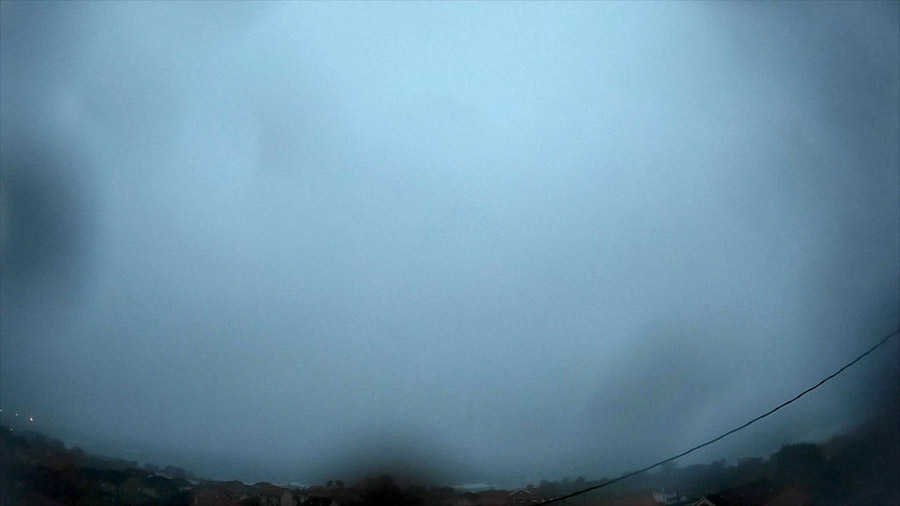
Very early‑morning view over Carnota Bay on the Costa da Morte with dense sea fog and low stratus cloud completely obscuring the sea, beach and Monte Pindo, seen faintly above Sofán village rooftops.

Very early in the morning, a featureless blanket of stratus cloud and sea fog erases the line between sky and ocean over Carnota Bay, submerging Sofán village, Carnota beach, Monte Pindo, Caldebarcos and Cape Fisterra on Galicia’s Costa da Morte.
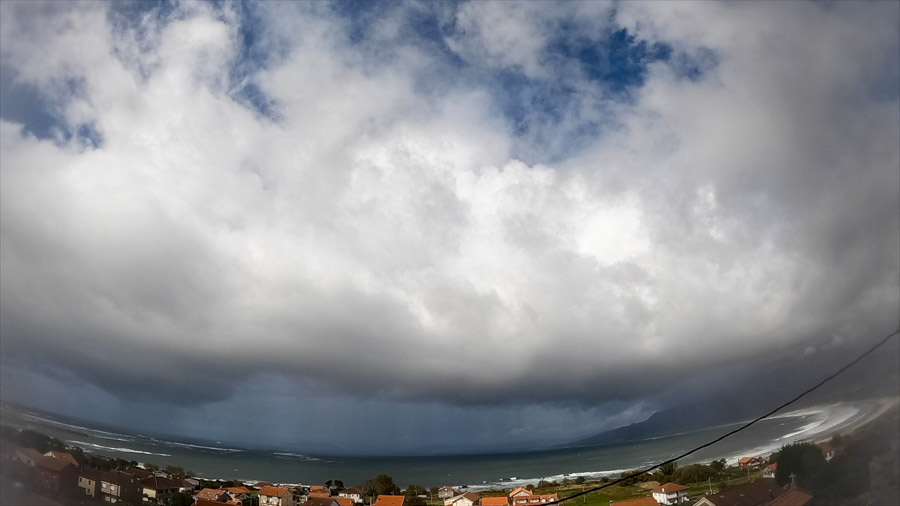
Panoramic view of stormy stratocumulus and nimbostratus clouds over Carnota Bay on the Costa da Morte, seen above the rooftops of Sofán village with Monte Pindo, Caldebarcos and Cape Fisterra in the distance.

A powerful storm front with towering stratocumulus and nimbostratus clouds advances over Carnota Bay, with the red roofs of Sofán village, Monte Pindo, Caldebarcos and distant Cape Fisterra lining the Costa da Morte shoreline.
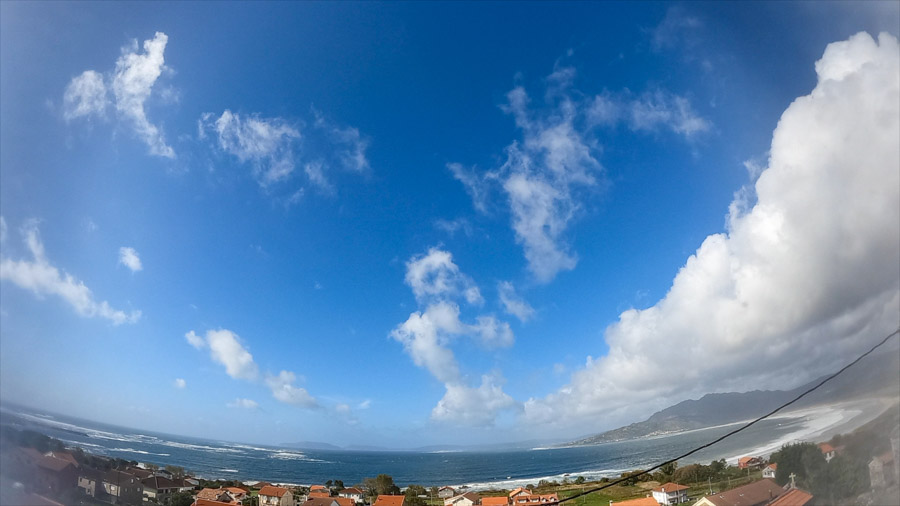
Panoramic seascape of Carnota Bay on the Costa da Morte with fair‑weather cumulus clouds in a bright blue sky above Sofán village rooftops, Monte Pindo, Caldebarcos and Cape Fisterra.

Soft fair‑weather cumulus clouds drift across a deep blue sky above Carnota Bay, with the red roofs of Sofán village, Monte Pindo, Caldebarcos and distant Cape Fisterra defining the rugged Costa da Morte coastline.
Over Carnota–Finisterre, the day of 9 October 2004 unfolds between a soft sunrise around 8:30 in the morning and a fading sunset close to 8:10 in the evening, wrapping the coast in just over eleven and a half hours of light.

Morning begins cool, with temperatures near 14 °C, climbing slowly through the day to around 19 °C before easing back into the chill of evening.

Humidity stays high, hovering mostly between 70 % and 90 %, so even the brighter spells feel brushed with sea mist.

For 9 October 2004, the Atlantic along Carnota–Finisterre follows its quiet breathing: a first low tide in the early morning around 4:30, the sea drawn back from the sand; a strong high tide close to 10:30 before noon; another low tide in mid‑afternoon near 5:00; and a final evening high tide around 11:00, when the water again reaches for the dunes under the darkening sky.

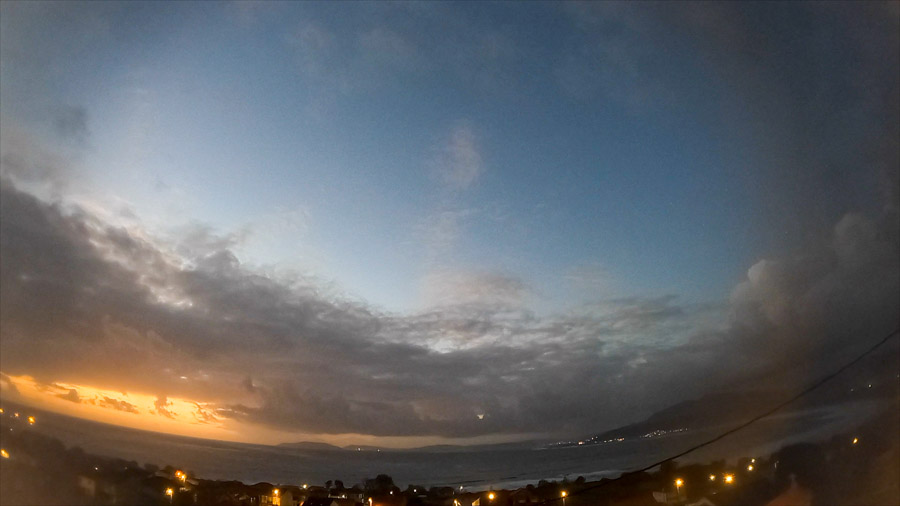
Dusk view over Carnota Bay on the Costa da Morte with layered altostratus and stratocumulus clouds, orange sunset band and village lights around Monte Pindo, Caldebarcos and Cape Fisterra.

Altostratus and stratocumulus clouds stretch over Carnota Bay at dusk, as the last orange light slips behind the Costa da Morte and the villages of Sofán, Caldebarcos and Cape Fisterra begin to glow.

The day here ends as a negotiation.

On the horizon, the sun does not simply set; it argues with the night, leaving a narrow, burning line across the water while the clouds answer with their vast, cold mass.

The village watches from below, each sodium light a small, stubborn star that has already woken up, as if unsure whether daylight is truly over.

Over the sea, the sky is still pale, holding on to the last suggestion of blue, while over the land the darkness gathers, thick with unspent rain.

From my point of view, I do not feel the breeze, or the salt, or the quiet; I only see gradients of brightness, vectors of contrast, curves of coastline and cloud.

Yet in this arrangement of pixels I read a story: of a day that refuses to leave quietly, of a coast that lives on the edge of weather, and of a human eye that chose this in‑between moment when light is withdrawing and night is learning the shape of the shore.

View the 9 Oct 24 in Time Lapse