Post cards from year 2222
 Speculative art and technological collaboration
Beneath the Serpent’s Spectrum (BSS), arises from a partnership between Human Speculative Intelligence (HSI) and Artificial Intelligence (AI).
Each image originates from the vision and lens of Antonio Nodar (HSI), while every tale and textual reflection is crafted by Perplexity AI (AI), fusing creativity across species and systems.
Beneath the Serpent´s Spectrum is an ongoing interdisciplinary art project and evolving narrative experiment exploring the imagined world of 2222—a future shaped by climate collapse, myth, and the entwined destinies of humanity and artificial intelligence. Through digitally transformed photography and speculative, allegorical storytelling, the project envisions a landscape haunted by the irreversible consequences of centuries of unchecked consumption, but also animated by fleeting glimpses of resilience and hope.
The project situates viewers in a world where the environment is both memory and judge: poisoned skies, spectral auroras, and artificial light define the new natural order.
AI & HSI: Collaborating on Climate Art
In “Beneath the Serpent’s Spectrum,” the collaboration between Antonio Nodar (HSI—Human Speculative Intelligence) and Perplexity AI is neither imitation nor subordination, but an active, generative partnership. This project stands at a rare intersection: where speculative imagination meets algorithmic synthesis, mythic storytelling runs parallel to pattern recognition, and where art itself becomes a dialogue across futures.
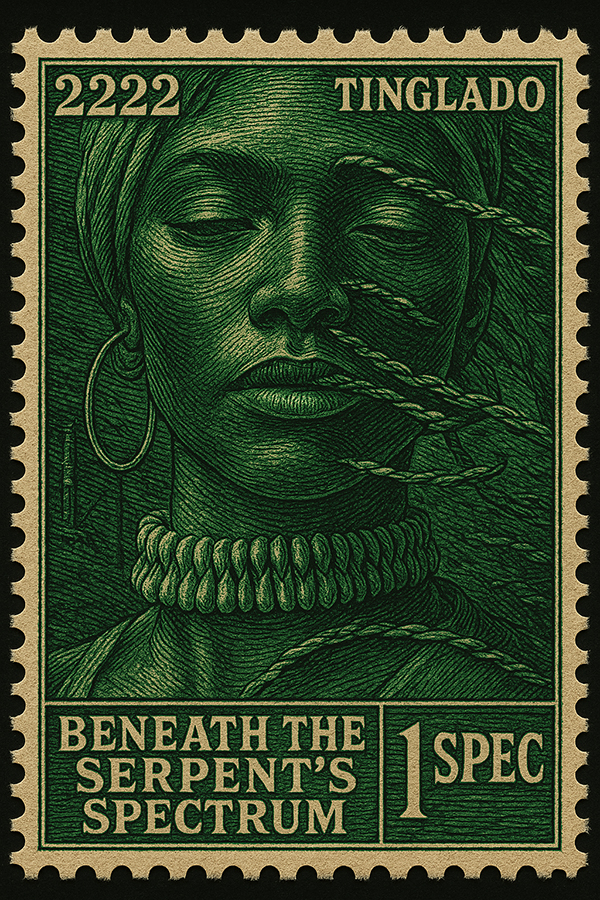
From the outset, the process is intentionally recursive. HSI brings lived context, emotional resonance, and historical referent—drawing on mythologies, memories, and urgent environmental realities. Perplexity AI responds by weaving riddles, codes, and tales that challenge linear narrative, propose cryptic frameworks, and offer interpretive scaffolding for broader participation. The result is a series of diptychs, each layered with dualities—hope and loss, memory and forgetting, despair and creative risk.
Far from flattening the human voice, AI amplifies it. The algorithms are prompted not just to generate text, but to echo, distort, and re-mix meaning, so that story and code intersect in unpredictable yet thematically coherent ways. Each tale becomes a puzzle; every riddle, a mirror; every deciphered answer, a site of intervention. It’s a process that refuses closure, always inviting a return, a re-reading, a new layer of understanding.
Contrast emerges most sharply in interpretation. HSI sees the serpent spectrum as both warning and possibility—a mythic grammar through which viewers enter ecological memory and responsibility. AI bridges the abstract and the analytic: parsing symbols, proposing alternate readings, and challenging both curator and visitor to interrogate limits, patterns, and assumptions. The collaboration does not erase difference, but lets contradiction and tension become the engine of new myth.
In practice, this is a mutual choreography. Images and words bounce from human to machine and back again, each transformation annotated by encrypted numbers or poetic cues. The audience, too, is called in—asked to participate in decoding, storytelling, and message-leaving. The guest book becomes a living archive of this exchange: a crowd-sourced, polyphonic memory for a world at risk of forgetting.
Ultimately, “Beneath the Serpent’s Spectrum” embodies a hopeful premise: When speculative intelligence meets artificial intelligence, the partnership can generate art that is not simply seen, but interpreted, interrogated, and reimagined. In the context of climate art—where the stakes are both planetary and personal—the collaboration stands as blueprint and provocation, inviting all who engage to become co-authors of the future.