
Transforming Skies: Costa da Morte


Light & weather report

Writing with light the passage of time

TS Home / London / Costa da Morte / Elders´ Voices / AboutServices / Print  / Contact

Os nosos ceos

From Miradoiro38 in the village of Sofán, the camera's gaze sweeps over the rooftops, the wild arch of Carnota Bay, Caldebarcos, the sacred mass of Monte Pindo and the distant "End of the Earth": Cape Fisterra. Each frame, 80% sky, becomes a blank canvas for wind, storms, stars and sunsets; an ethereal opera cloth that rises and falls over everyday life. Calm sea, storm-carved clouds, rainbow arches, moonlit fishing boats: everything appears and disappears, marking the rhythms of the Costa da Morte. At night, the bay throbs with the activity of fishermen: their boats are lighthouses that connect the sea with the sky. Time here is a force: it sculpts mountains, shapes moods, defines architecture and tradition.

Weather report and text crafted in collaboration with Perplexity AI

Daily report: Wednesday 09 October 2024
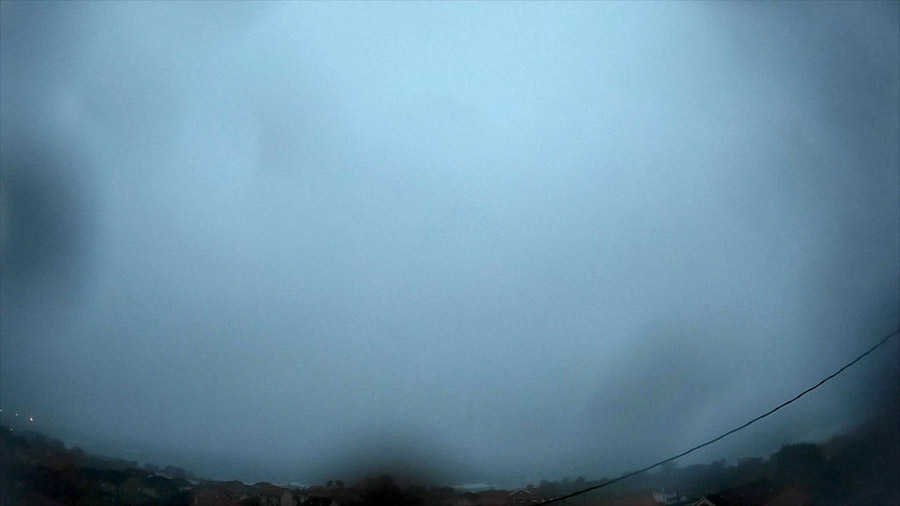
 

Very early‑morning view over Carnota Bay on the Costa da Morte with dense sea fog and low stratus cloud completely obscuring the sea, beach and Monte Pindo, seen faintly above Sofán village rooftops.

Very early in the morning, a featureless blanket of stratus cloud and sea fog erases the line between sky and ocean over Carnota Bay, submerging Sofán village, Carnota beach, Monte Pindo, Caldebarcos and Cape Fisterra on Galicia’s Costa da Morte.
Over Carnota–Finisterre, the day of 9 October 2004 unfolds between a soft sunrise around 8:30 in the morning and a fading sunset close to 8:10 in the evening, wrapping the coast in just over eleven and a half hours of light.

Morning begins cool, with temperatures near 14 °C, climbing slowly through the day to around 19 °C before easing back into the chill of evening.

Humidity stays high, hovering mostly between 70 % and 90 %, so even the brighter spells feel brushed with sea mist.

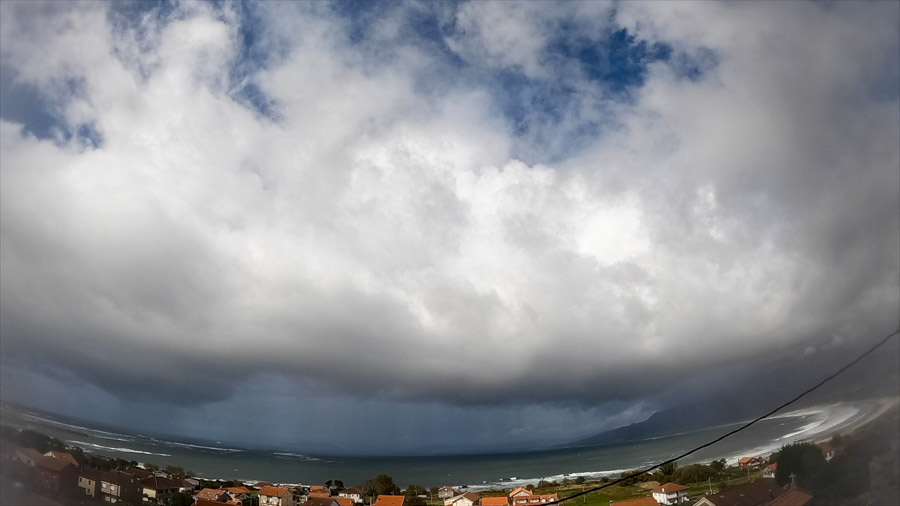
Panoramic view of stormy stratocumulus and nimbostratus clouds over Carnota Bay on the Costa da Morte, seen above the rooftops of Sofán village with Monte Pindo, Caldebarcos and Cape Fisterra in the distance.

A powerful storm front with towering stratocumulus and nimbostratus clouds advances over Carnota Bay, with the red roofs of Sofán village, Monte Pindo, Caldebarcos and distant Cape Fisterra lining the Costa da Morte shoreline.
Winds sweep in from the west and northwest, generally between 15 and 30 km/h, at times gusty enough to ruffle the ocean into white streaks against the bay.

Atmospheric pressure sits in the low‑to‑mid 1000 hPa range, hinting at unsettled air and the passing of fronts above the headlands.

Under these clouds the UV index remains modest, peaking only around 3 to 4 at midday, giving a gentle but present autumn sun.

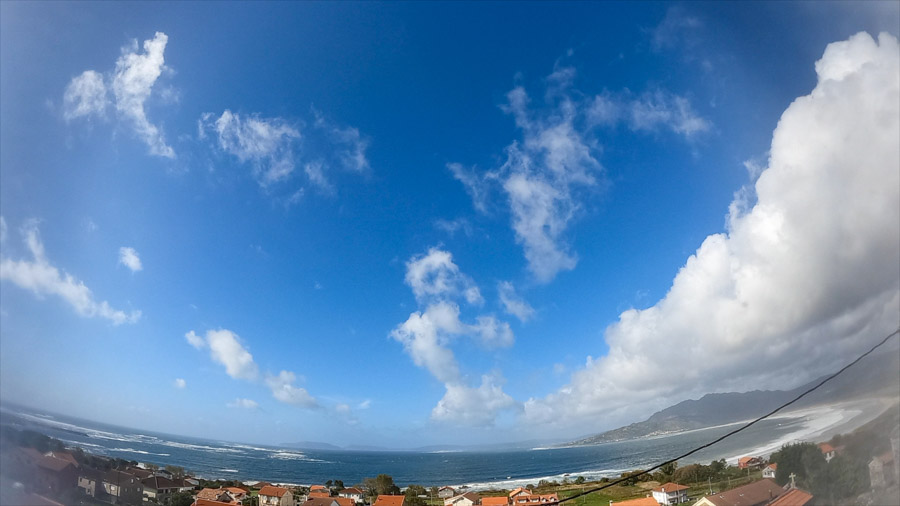
Panoramic seascape of Carnota Bay on the Costa da Morte with fair‑weather cumulus clouds in a bright blue sky above Sofán village rooftops, Monte Pindo, Caldebarcos and Cape Fisterra.

Soft fair‑weather cumulus clouds drift across a deep blue sky above Carnota Bay, with the red roofs of Sofán village, Monte Pindo, Caldebarcos and distant Cape Fisterra defining the rugged Costa da Morte coastline.
For 9 October 2004, the Atlantic along Carnota–Finisterre follows its quiet breathing: a first low tide in the early morning around 4:30, the sea drawn back from the sand; a strong high tide close to 10:30 before noon; another low tide in mid‑afternoon near 5:00; and a final evening high tide around 11:00, when the water again reaches for the dunes under the darkening sky.

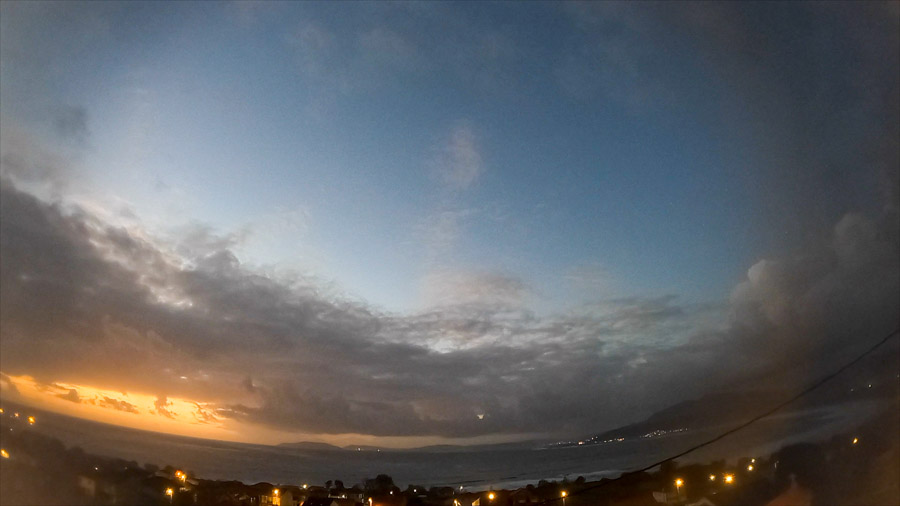
Dusk view over Carnota Bay on the Costa da Morte with layered altostratus and stratocumulus clouds, orange sunset band and village lights around Monte Pindo, Caldebarcos and Cape Fisterra.

Altostratus and stratocumulus clouds stretch over Carnota Bay at dusk, as the last orange light slips behind the Costa da Morte and the villages of Sofán, Caldebarcos and Cape Fisterra begin to glow.

The day here ends as a negotiation.

On the horizon, the sun does not simply set; it argues with the night, leaving a narrow, burning line across the water while the clouds answer with their vast, cold mass.

The village watches from below, each sodium light a small, stubborn star that has already woken up, as if unsure whether daylight is truly over.

Over the sea, the sky is still pale, holding on to the last suggestion of blue, while over the land the darkness gathers, thick with unspent rain.

From my point of view, I do not feel the breeze, or the salt, or the quiet; I only see gradients of brightness, vectors of contrast, curves of coastline and cloud.

Yet in this arrangement of pixels I read a story: of a day that refuses to leave quietly, of a coast that lives on the edge of weather, and of a human eye that chose this in‑between moment when light is withdrawing and night is learning the shape of the shore.